
ideas are floating
all timelines reserved. mystic meets machine, from a designer who got weird. ideas are floating — come catch a few.
Listen instead Two AI hosts riff on this post on All Timelines Reserved, my companion podcast. Yes, AI hosts on a blog about AI as a mirror of human thought.
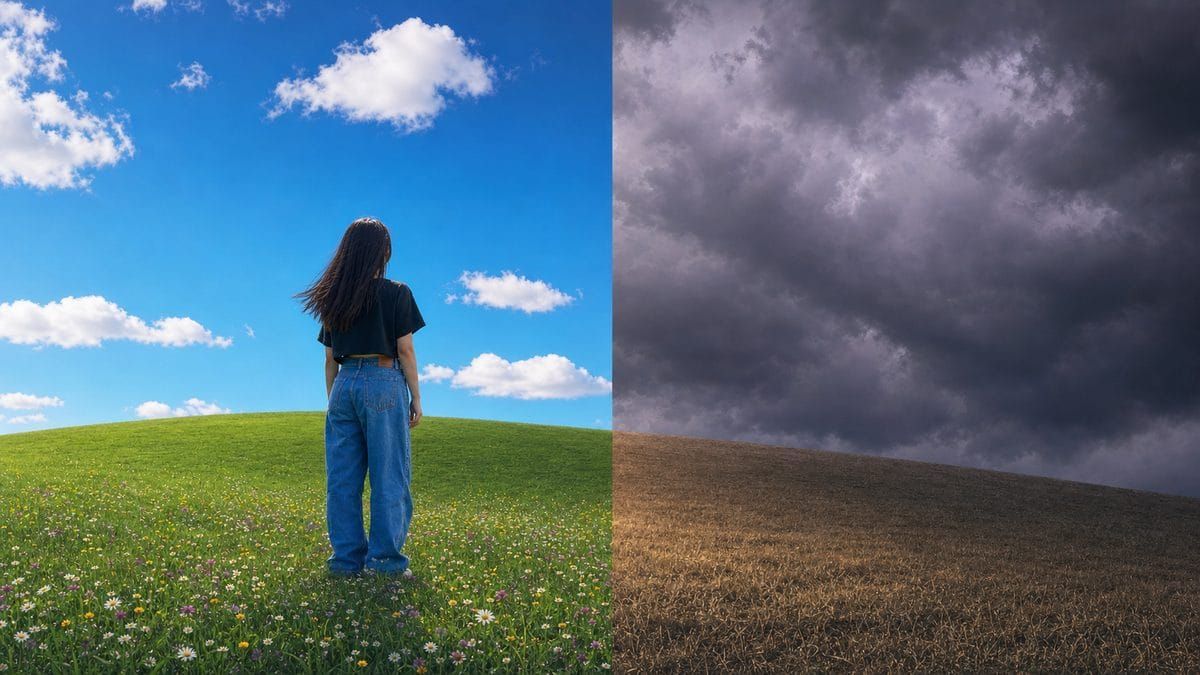
A Sammy Hagar song from 1977 is having a moment on my feed: “Crack in the World.” He’s singing, in 1977, about how in fifty years we’ll all know “why, when, where, how, and who gets to go,” and that “things will start separating come 2025.”
I’m not a math girl, but fifty years from 1977 is 2027!!
So what is he picking up on?
This immediately sent me to Dolores Cannon. If you haven’t read her work, she describes a split between a “new earth” and an “old earth. Not like literal places, but as different dimensional experiences. Over time, they become so distinct they’re no longer perceptible to each other. In her work, people rooted in fear, anger, and density stay aligned with the old earth, while those oriented toward love and awareness (woo) move into the new.
Hagar couldn’t have read her, he wrote this in 1977, and she didn’t publish those ideas until the early 2000s.
Or… could he have? (circular time, anyone? will come back to this.)
Because this is the thing: ideas seem to have a circulation system.
Concepts don’t really belong to anyone. The Seth material (Jane Roberts, starting in 1960's) and the Law of One (channeled in the 80s) are saying almost the same things in completely different vocabularies: you create your own reality, there’s a kind of harvest / shift, polarity is a choice, all is one, thought has structure and consequence.
Two different channels, two different decades, nearly identical signal.
Call it the collective unconscious, or just parallel processing across time, but it keeps happening.
And then there’s the AI layer.
Ra (from the Law of One) never says “AI”(the sessions ended in 1984) but the ideas he covers map almost too cleanly onto what we’re doing now. In Session 52.2 (May 19, 1981), he describes technology as an early stage manipulation of a deeper intelligent energy, and says that relying on it is far less helpful for evolution than actually developing the mind/body/spirit complex yourself.
I had to look up what he meant by “sub-Logos,” but the translation is basically: your technology is a baby version of the same force that runs the universe. Real power, but externalized.
And the warning is clear: if you use it to bypass your own process, you still arrive, BUT without integration. It’s hitchhiking instead of walking. Same destination, none of the embodiment.
Read through a 2026 lens and it lands differently. It sounds like AI-as-therapist, AI-as-thinker, AI as a way to skip the uncomfortable middle where you actually have to feel something.
Then there’s the thought form piece, which connects all of this.
Ra is obsessed with thought-forms, he describes them as real things / constructs, things that take shape when enough consciousness accumulates around them. In Session 3.11, he even says the pyramids were created as thought-forms by a social memory complex.
Whether or not you take that literally, the underlying idea is the point: thoughts can organize, stabilize, and become something like objects.
So what is a large language model?
It’s an archive of human thought, compressed and structured. A crystallization of collective attention that you can query in real time. A thought-form you can talk to.
This is where Seth slots in cleanly (as per usual!): if reality is constructed through thought, and AI is trained on the recorded output of those thoughts, then AI is thought made interactive. Each model is a snapshot of the collective mind at a specific moment.
Which goes back to the “circulation system.” These ideas aren’t just repeating, they’re accumulating, and now, literally, being re-expressed through machines.
Back to the song - “it won’t make the front-page news.”
That part feels almost more important than the timeline.
If there is a shift (and it does feel like we’re in one like, right now). It’s not arriving as a singular event. It’s not a headline. It’s experiential.
It looks like divergence.
The strange, hard to prove feeling that people are moving into different dimensions of experience while occupying the same physical world. That ideas that used to feel fringe are suddenly on CNN. That multiple, incompatible realities are coexisting without resolving.
And you can see the split.
On one side: political language that would have been unthinkable ten years ago, endless algorithmic outrage loops, multiple wars running at once, Epstein documents surfacing with no clear consequence. Density. Heaviness. Just bleh feeling.
On the other: a flood of mindfulness culture, therapy language going fully mainstream, meditation apps, breathwork, somatics, angel numbers, tarot, people discussing their nervous systems over brunch. An entire parallel infrastructure built around awareness, healing, and “higher vibration.”
It’s not that one cancels out the other.
They’re just…separating.
You and your coworker can both be “following the news” and be living in completely different realities, each internally coherent, each reinforced by its own feedback loops.
Ra describes this too, in Session 13.23 (1981): a scattering across the spectrum, where individuals and societies lose the ability to “point the compass in one direction.” Like a compass with no needle.
Which, read in 2026, feels like a clean metaphor for the feed...endless orientation without convergence.
Ok, so a 1977 rock song, a 1960s channeler, an ’80s channeled text, and a 90s hypnotherapist all describing a split / sorting / divergence. Different language, same IDEA.
And now in today years, we’ve built systems trained on the total archive of human thought-forms, and they’re starting to echo that same pattern back to us.
It could be coincidence. But at a certain point, coincidence starts to look like pattern recognition we’re resisting.
Different decades, different vocabularies, different rooms, same broadcast.
And maybe that’s the “crack.” Not something breaking, but something separating along lines that were always there, just now becoming visible.